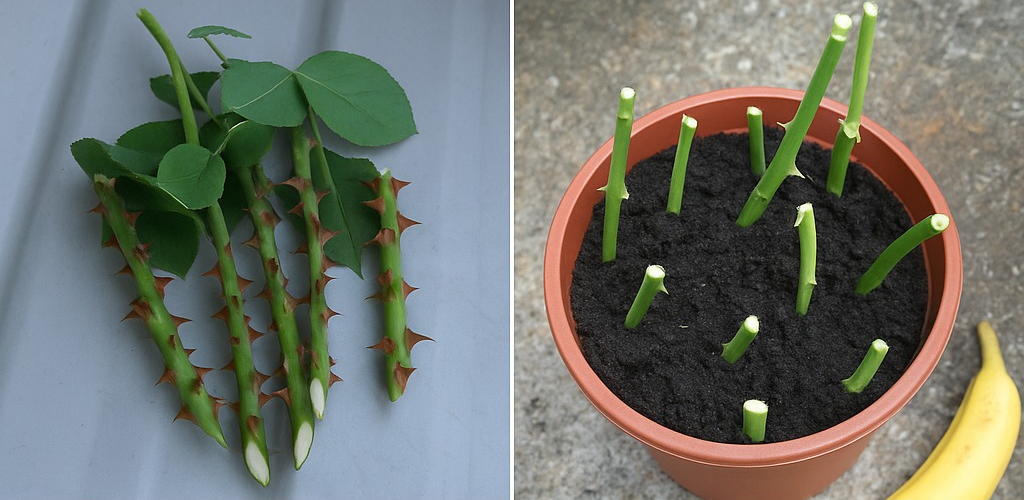
Rose cuttings can really grow dozens of new rose bushes in your garden! This is a cost-effective and exciting way to propagate your favorite roses. The key to success is the right timing, choosing good quality cuttings, and careful care.
When to Propagate Roses?
The best time to take rose cuttings is late summer and early fall (August-September), when the shoots are already semi-woody, i.e. not completely green and tender, but not yet completely woody. At this time, the energy accumulated in the plant helps rooting.
How to choose and prepare cuttings?
Choose the right shoot: Look for healthy, strong, disease-free shoots that have bloomed in the given year. The flower has already faded, but the stem has not yet completely woody. A stem the thickness of a pencil is ideal.
Pruning: Cut cuttings about 15-20 cm long. Make the cuts with sharp, clean pruning shears to avoid damaging the stem.
The lower cut should be at an angle (45 degrees), just below a bud.
The upper cut should be straight, about 1 cm above a pair of leaves or a bud.
Preparation:
Remove the lower leaves, leaving only 2-3 leaves at the top of the cutting. If the leaves are large, cut them in half to reduce evaporation.
Remove all thorns from the bottom.
Rooting hormone (optional, but recommended): Dip the lower, angled end of the cuttings in rooting hormone powder or gel. This significantly increases the chances of rooting.
Cutting methods:
There are several methods for rooting rose cuttings, choose the one that suits you best. The goal is always to ensure the right humidity and temperature.
- Rooting in soil (the most common and successful):
Planting medium: Prepare a well-draining, nutrient-poor planting medium. A mixture of perlite and peat or sandy potting soil is ideal (you can add sand for better drainage). The main thing is not to compact it and not to hold moisture for too long.
Planting:
Fill small pots (about 10 cm in diameter) with the medium and moisten it thoroughly.
Make a hole in the medium (e.g. with a pencil) and carefully insert the cutting (about 5-7 cm deep), so that the lower buds are underground. Do not press the soil down too hard to avoid damaging the hormone-treated end of the cutting.
You can plant several cuttings in a larger pot, but keep at least 5-10 cm between them.
Provide humidity: This is the most important step for success!
Jar/PET bottle method: Cover the cutting with a clear jar or a plastic PET bottle with the bottom cut off to create a mini greenhouse effect. This will help maintain high humidity and protect the cutting from drying out. Lift the jar 1-2 times a day to ventilate and check the humidity.
Mini greenhouse: If you are making several cuttings, place them on a tray or balcony box, then cover the whole thing with a transparent plastic bag or foil, which you secure with a rubber band. This also creates a greenhouse effect.
Location and temperature: Place the pots in a bright place, but protected from direct sunlight. The ideal temperature for root development is 18-24°C.
Watering: Keep the planting medium constantly moist, but not wet. Less watering is needed under a glass jar.
Rooting: Rooting usually takes 4-8 weeks. We will know that it was successful when new shoots and leaves appear on the cutting. At this point, gradually accustom the plant to the outside, drier air (first remove the glass/foil for a short time, and then for longer periods). - Rooting with potatoes (alternative, popular method):
This method is also based on providing high humidity and moisture, the potatoes also provide nutrients.
Choose a healthy, fresh potato.
Cut a hole in the potato (e.g. with a screwdriver or drill) that will fit the base of the rose cutting.
Prepare the cutting as described above (lower oblique cut, removal of leaves, rooting hormone).
Insert the cutting into the potato.
Dig a hole about 15 cm deep in the ground, in a partially shaded place. Sprinkle a little sand on the bottom for better drainage.
Place the cutting inserted into the potato in the hole, so that about half to two-thirds of the cutting is above the ground.
Fill the hole with soil and water it thoroughly.
Cover it with a PET bottle or mason jar (as above) to create a mini greenhouse effect.
Regularly water the soil around the cutting to keep it moist.
- Rooting in water (less effective, but possible):
This method is less reliable for roses, because roots that develop in water have a harder time adapting to the soil, and there is a greater risk of rotting. If you do choose this: