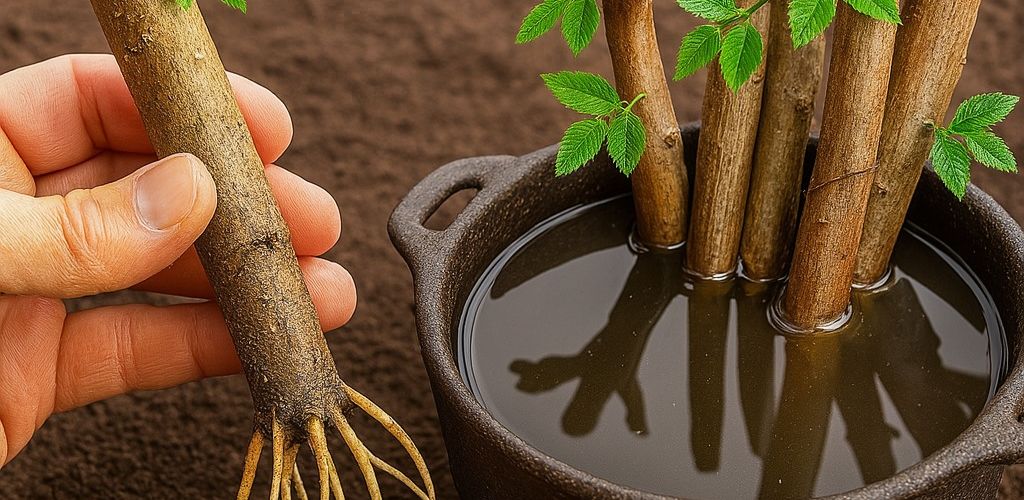
The Best One-Ingredient Rooting Technique (to Increase Chances) 🌱✨
The technique that maximizes rooting chances with a single “ingredient” (which serves as a rooting hormone or protective agent) generally involves:
Choosing the correct cutting.
Properly preparing the cutting.
Using a natural agent that promotes rooting or prevents disease.
The rooting medium and environmental conditions.
Considering an “ingredient” that most people have or can easily find, the best rooting options are:
- Willow Water 💧🌳
The Ingredient: Willow itself (fresh twigs and leaves).
Why it works: Willow (any Salix species) naturally contains indolebutyric acid (IBA) and salicylic acid. IBA is an auxin, a plant hormone that stimulates root growth. Salicylic acid (the active ingredient in aspirin) has anti-inflammatory and antimicrobial properties, helping to prevent fungal diseases in cuttings.
Prepare the twigs: Cut the twigs into small pieces (1-2 cm long).
Prepare the Willow Water:
Hot Method (Quicker): Place the willow pieces in a heatproof container and cover with boiling water (about 1 part willow to 3 parts water). Let it steep for 24 hours, then strain the liquid.
Cold Method (Longer): Place the willow pieces in a jar and cover with cold water. Let it steep for 3-5 days (or up to a month for a stronger concentration), then strain the liquid. Use for Rooting:
Soaking: Soak the cut end of your cuttings (the branch you want to root) in willow water for a few hours before planting them in the rooting medium (water, soil, or potting mix).
Watering: Use the willow water to water the rooting medium of your cuttings.
Water Propagation: You can even use willow water directly as the rooting medium for cuttings that root well in water.
- Aloe Vera 🌿🌵
The Ingredient: Fresh gel from an aloe vera leaf.
Why it works: Aloe vera contains enzymes, vitamins, minerals, and compounds that promote plant growth and have antibacterial and antifungal properties, helping to protect the cutting from rot. Although it doesn’t contain auxins (rooting hormones) in large quantities like willow, its protective effect is very valuable.
How to Make and Use:
Get Fresh Gel: Cut a mature leaf from an aloe vera plant (if you have one at home in Ternopil). Leave the leaf vertically for 10-15 minutes to allow the yellow sap (aloin) to drain (it can be irritating to some skin types).
Extract the Gel: Cut open the leaf and scrape out the clear gel with a spoon.
Prepare the Cutting: Cut your cutting (the branch you want to root) just below a node (where the leaves meet the stem) using a clean, sharp knife. Remove any lower leaves that would be submerged.
Apply the Gel: Dip the cut end of the cutting directly into the aloe vera gel, thoroughly covering the cut area. Plant: Immediately plant the cutting in a suitable rooting medium (water, well-draining potting soil, or a mixture of sand and peat).
Essential Tips for Successful Rooting (Besides the Ingredient):
Even with a powerful “ingredient,” these practices are crucial to achieving high success rates:
Healthy Cuttings: Choose healthy branches, free of diseases and pests. Avoid very old or very young, soft wood.
Correct Cut: Make a clean, angled cut (45 degrees) just below a node. The node area is where the root growth cells are most active.
Remove Lower Leaves: Remove leaves that would be submerged in water or buried in the soil to prevent rot.
Suitable Rooting Medium:
Water: Good for some plants (e.g., rosemary, mint, philodendrons, pothos). Use tap water that has been allowed to stand for 24 hours to allow the chlorine to evaporate, or filtered water. Change the water every few days.
Soil/Substrate: For most plants, a light, well-draining mix (such as equal parts sand, peat moss, and/or perlite) is ideal. Do not use garden soil, as it may contain pathogens.
Ambient Humidity: Some cuttings benefit from high humidity. You can create a “mini-greenhouse” by covering the pot with a clear plastic bag with a few holes for ventilation.
Indirect Light: Keep the cuttings in a location with bright but indirect light. Direct sunlight can be too intense and dehydrate the cuttings.
Patience: Rooting takes time, which can range from weeks to months, depending on the plant species.