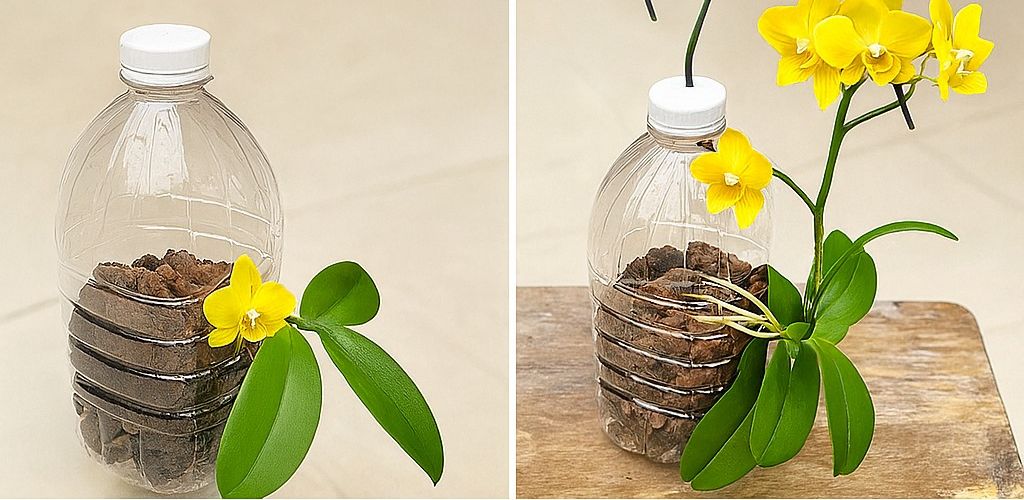
- Choosing a substrate: The Anti-Rot Secret 🌳💧
This is undoubtedly the MOST critical factor in preventing rot and promoting healthy growth. Epiphytic orchids (the most common, like Phalaenopsis) don’t grow in soil!
What to Use: Use a substrate specifically for orchids, which usually contains:
Pine bark: Provides excellent aeration and drainage.
Charcoal: Helps with aeration, absorbs impurities, and prevents compaction.
Coarse coconut fiber: Retains some moisture without becoming soggy.
Perlite or vermiculite: For aeration and minimal water retention.
Why It’s Crucial: Orchid roots need plenty of air. In a common soil substrate, the roots suffocate, become waterlogged, and rot quickly. A suitable substrate allows water to drain freely and air to circulate between the roots, mimicking their natural environment in trees.
- Proper Pot: Drainage and Aeration Are King 🪴💨
The type of pot is as important as the substrate.
Material:
Clear plastic pots: These are ideal for beginners. They allow you to see the condition of the roots (healthy roots are green/silver, rotten roots are brown/black and soft) and the moisture level of the substrate.
Clay (terracotta) pots: These offer good aeration and dry out faster, which can be beneficial for those who tend to overwater. However, they can dry out too quickly for some species or climates.
Drainage: Make sure the pot has numerous large drainage holes in the bottom. Extra holes on the sides are also a plus. Excess water should drain away immediately. Size: Don’t use a pot that’s too large. Orchids like tight-fitting pots. A large pot retains too much moisture, and the potting medium can take a long time to dry, increasing the risk of rot. Only increase the pot size when the roots completely fill the current pot.
- The Correct Planting/Transplanting Process 🪴👐
When planting or transplanting, technique is key.
Remove the orchid from the old pot: Do this carefully.
Clean the roots: Remove all the old potting medium from the roots. This step is vital, as the old potting medium may be compacted and retaining water.
Inspect and prune the roots: Using sterilized scissors (clean with alcohol), cut off any roots that are soft, brown, black, or have a foul odor (signs of rot). Healthy roots are firm and whitish or green (if moist). Place the orchid in the new pot: Position the orchid so that the base of the plant (the “neck,” where the roots and leaves meet) is slightly above the substrate line, not buried. This is crucial to prevent root rot.
Add the new substrate: Fill the pot with the new substrate, gently shaking the pot and tapping the sides so that the substrate settles between the roots. Don’t pack the substrate tightly; it should be loose to allow aeration.
- Watering: The Art of Balance 💧⚖️
Incorrect watering is the second biggest cause of problems.
When to water: Water only when the substrate is almost dry. The best way to check is to feel the weight of the pot (a dry pot is lighter), look through a clear pot (if the roots are silvery, they need water; if they are green, they are still moist), or stick a wooden toothpick into the substrate and check if it comes out dry. How to water: Water thoroughly, letting the water run freely through the drainage holes for several minutes. You can submerge the pot in a bowl of water for 10-15 minutes and then let it drain completely.
Avoid standing water: Never leave the orchid in a dish of standing water. Excessive moisture on the roots leads to rot.
Good water quality: If the tap water in Ternopil is very hard, consider using rainwater or filtered water.
- Humidity and Air Circulation: As in the humid tropics 🌬️
Orchids love humidity but hate stagnant air.
Humidity: Place the orchid near a tray of pebbles and water (the water evaporates and increases the local humidity). Humidifiers are also an option, especially during the dry winter months in Ternopil.
Air Circulation: This is vital. Ensure there is good airflow around the plant to prevent the growth of fungi and bacteria, which can cause rot. Avoid closed, stuffy spaces. Gentle ventilation is ideal.
- Light and Fertilization: For Fast Growth ☀️🥣
Light: Orchids need bright, but indirect light. An east- or west-facing window is usually ideal. Direct sunlight can burn the leaves. Too little light will result in few flowers and slow growth.
Fertilization: Use a fertilizer specifically for orchids, diluted to half the recommended strength, and apply every two or three waterings. Flush the substrate with water only every few waterings to prevent salt buildup.