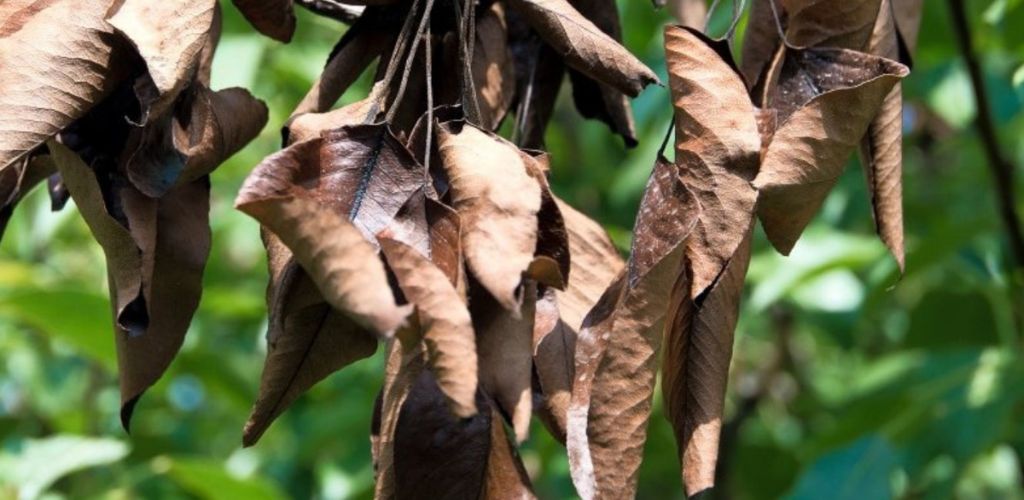
Blackened shoots, shrunken flowers or dried fruits hanging like embers – these are all warning signs that a fruit tree is suffering, but it doesn’t always mean it’s over. Hasty pruning can do more harm than good. First, find out what you have the honor of dealing with – and then act. Here are the three most common diseases that can affect your fruit trees, and how to deal with them without panic.
🍂 1. Anthracnose – a creeping destroyer of leaves and fruits
How do you recognize it?
Brown-red spots appear on the leaves, which merge. The shoots begin to turn gray, and black, sunken dots form on the fruits. Fruits infected in this way often remain on the branches and look charred.
What to do?
Remove infected leaves and fruits (burn them!).
Scrape off dead areas from the bark down to healthy tissue.
Sprays:
Champ 77 WG (copper fungicide) – 30–40 g / 10 l of water
Zorvec Zelavin Bria – modern systemic spray – 1–2 ml / 1 l of water
Gamair – biological preparation with Bacillus subtilis – 10 tablets / 10 l of water
🌡️ 2. Bacterial fire blight of rosettes (Erwinia amylovora)
How do you recognize it?
Young shoots and flowers turn black and hang down – as if they were burned. The tips of the shoots typically bend into a hook shape.
What to do?
Cut the branches at least 30 cm below the damage point.
Disinfect tools after each cut!
Sprays:
Bordeaux solution 1% (blue stone + slaked lime)
Champion 50 WP – 30–40 g / 10 l of water
Fitolavin 300 (antibiotic) – 20 ml / 10 l of water – use only in case of serious infestation
🔥 3. Monilial blight – silent destroyer of flowers and branches
How do you recognize it?
The flowers look as if they have been burned by fire. The shoots quickly wither, turn brown, later cracks appear and resin leaks. The affected fruit rots right on the tree.
What to do?
Remove and dispose of the affected parts.
Suitable sprays:
Chorus 50 WG – 3 g / 10 l water
Score 250 EC – 2.5 ml / 10 l water
Coprantol Duo – 40 g / 10 l water (copper spray for prevention)
🔁 Recommendations for the entire orchard:
Do not over-fertilize with nitrogen – it promotes soft tissue that is easily infected.
Prune regularly for better air flow.
Do not use the same spray repeatedly – rotate products to prevent resistance.
Spray on time – ideally in early spring and repeatedly after flowering.
Follow the weather forecast – most diseases spread in heat and humidity.
📊 Clear comparison:
🦠 Disease 💊 Product ⚗️ Substance 🧴 Dosage 📆 Use
Anthracnose Champ 77 WG Copper oxychloride 30–40 g / 10 l Spring / after harvest
Gamair Bacillus subtilis 10 tablets / 10 l Spring prevention
Pink spot Bordeaux mixture copper sulfate + lime 100 + 100 g / 10 l After cutting
Fitolavin 300 antibiotic 20 ml / 10 l When the disease develops
Monilial spot Score 250 EC Difenoconazole 2.5 ml / 10 l Spring
Coprantol Duo Copper 40 g / 10 l Autumn prevention
Remember: Not every dry shoot is a cause for alarm – but ignoring the first symptoms can be fatal. Do not make hasty cuts. First, observe, identify the problem and act thoughtfully. Your fruit trees will thank you with a rich harvest! 🍎🌳
Do you grow an orchard? Share your experiences or photos – we will advise together!