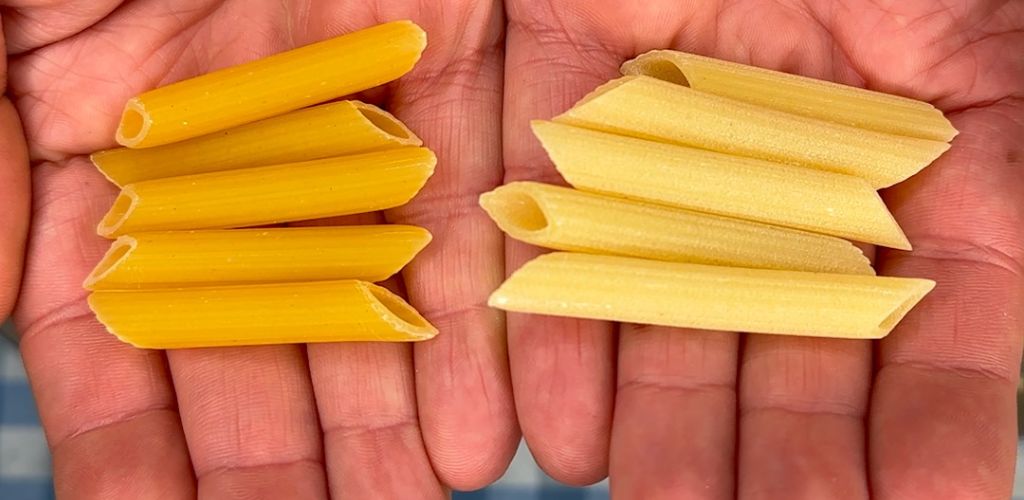
Very good question! The color of pasta depends on many factors, and they all contribute to the final result being a lighter or darker shade. Here are the most important reasons:
Why are some pastas darker and others lighter?
- Type and quality of flour
Durum wheat (hard wheat): Most high-quality Italian dry pasta is made from durum wheat. The semolina of this wheat is naturally more yellowish in color due to the carotenoids (xanthophylls) it contains. The higher the concentration of these pigments, the more yellow the pasta will be.
Aestivum wheat (common wheat): Pastas made from traditional wheat flour (which we also use for bread and cakes) are usually lighter, whiter, because this flour has a lower carotenoid content.
Milling grade / Ash content: The “ash content” of flour indicates the amount of minerals and bran particles it contains. The higher the ash content (e.g., whole wheat flour), the darker the dough will be because it contains more bran and minerals. Pastas made from refined flours are lighter. - Adding eggs
Egg-based pastas: Eggs, especially the yolks, give the dough a bright yellow color. The more eggs (or just the yolks) the dough contains (e.g., homemade pastas with 4 or 8 eggs), the deeper the yellow the color will be. The color content of the eggs also depends on the breed of hen and her diet.
Egg-free pastas: These pastas rely only on the natural colorants in the flour, so they are usually paler. - Drying Process
High-Temperature, Rapid Drying: Some industrial pasta manufacturers dry their pasta at higher temperatures, more quickly. This process (due to the so-called Maillard reaction, which is responsible for browning) can caramelize the sugars on the surface of the pasta, resulting in a yellower, darker shade. While this faster drying may be more economical, some believe it can compromise the quality and nutritional value of the pasta (e.g., the availability of certain amino acids).
Low-Temperature, Slow Drying: Premium pasta is often dried at lower temperatures, for longer periods of time. This preserves the natural color of the flour, so such pasta is usually lighter, ivory, or pale yellow. - Added Ingredients
The color of pasta can be significantly affected by added natural dyes or flavors:
Darker pastas:
Sepia ink (black/cuttlefish ink): Produces a black pasta.
Tomatoes/peppers: Gives an orange, reddish hue.
Spinach/green herbs: Gives a greenish color.
Wholemeal flour/rye flour: Darker, browner pasta.
Yellower/lighter pastas:
Saffron: Gives an intense golden yellow color.
Turmeric: Also gives a yellow color.
In summary, the color of pasta says a lot more than you might think – from the quality and type of ingredients to the manufacturing technology. In general, lighter, ivory-colored pastas (especially made from durum wheat, slowly dried) often indicate higher quality, but darker pastas made with added ingredients can also be excellent!