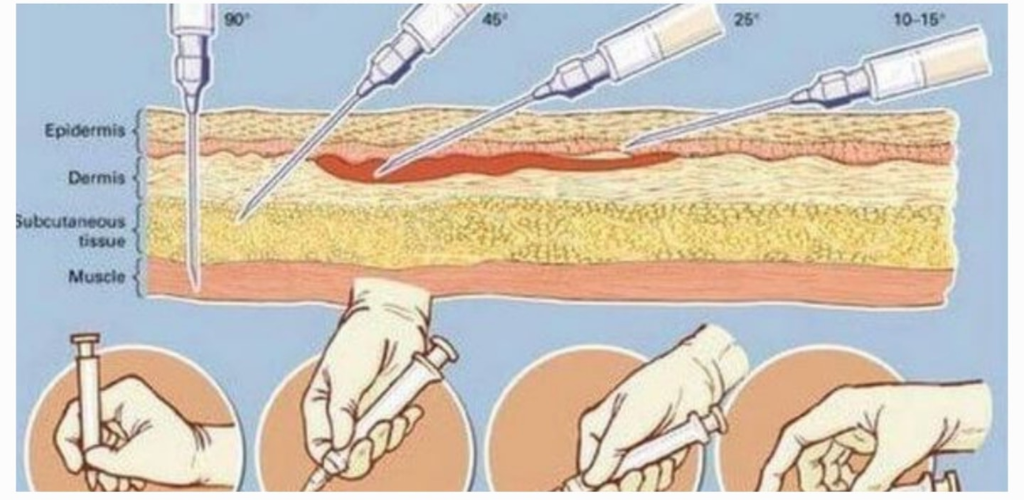
I understand that you are looking for information on how to apply injections correctly. It is a skill that, if done safely and effectively, can be very useful in certain situations. However, it is absolutely crucial to emphasize that the application of injections should always be performed by a qualified health professional. Self -administration or administration by uncooked and authorized people can lead to serious complications, such as:
Infections: If the technique is not sterile, bacteria can be introduced, causing local or systemic infections.
Nerve damage, blood vessels or other tissues: an injection applied in the wrong place can reach nerves, causing intense pain, numbness or even paralysis. It can also pierce blood vessels, leading to bruising or bleeding.
Medicine malabsorption: If the drug is not applied to the correct layer of the tissue, its absorption and effectiveness may be compromised.
Allergic reactions: In case of an unexpected allergic reaction, the rapid intervention of a professional is vital.
Excessive pain and discomfort: An incorrect technique can make the injection much more painful.
Why should only a professional apply injections?
Health professionals (doctors, nurses, pharmacists) are trained in:
Anatomy: They know the safe and effective places for each type of injection, avoiding important nerves and vessels.
Aseptic techniques: They know how to prevent infections.
Injection types: distinguish between intramuscular (muscle), subcutaneous (under the skin) and intravenous (in the vein) injections, and the right angle for each.
Drug Preparation: They know how to reconstruct medications, accurately measure doses and handle different types of substances.
Complicity Management: They are prepared to deal with adverse reactions or complications.
When can a patient be involved in the application?
In some specific situations and after training and guidance detailed by a healthcare professional, patients or their caregivers may be instructed to self -apply injections. This usually happens with medicines for chronic conditions, such as:
Insulin: For diabetes.
Heparin: For coagulation problems.
Adrenaline (Epipen): For severe allergic reactions.
Certain medicines for multiple sclerosis or rheumatoid arthritis.
In such cases, training is rigorous and covers:
Correct storage of the medicine.
Sanitization of hands.
Preparation of the application site.
Specific injection technique for that medicine (angle, depth, speed).
SAFE DISPLAY OF NEEDLE AND SYRINAGES.
Recognition of warning signs and what to do in case of problem.
The best important information for you:
The most important information you should keep for you is: the safety of your health comes first.