Exercises to Relieve Knee, Foot, and Hip Pain
These exercises are designed to strengthen the muscles around the joints, improving stability and flexibility.
- Straight Leg Raises (To Strengthen Quadriceps and Hip Flexors)
Benefits: Helps strengthen the thigh muscles (quadriceps) without putting stress on the knee, and also works the hip flexors.
How to do it:
Lie on your back on the floor or a mat, with one leg straight and the other bent with the foot flat on the floor.
Squeeze the thigh muscles of the straight leg and slowly raise it about 6-8 inches off the floor (or to the height of the knee of the bent leg), keeping the knee straight.
Hold for 3-5 seconds and then slowly lower.
Do 2-3 sets of 10-15 reps on each leg. - Bridge (To Strengthen Glutes and Hamstrings)
Benefits: Strengthens the glutes and hamstrings, which are crucial for hip support and knee stabilization.
How to do it:
Lie on your back with your knees bent, feet flat on the floor shoulder-width apart, and arms extended at your sides.
Squeeze your glutes and lift your hips off the floor until your body forms a straight line from your shoulders to your knees.
Hold the position for 2-3 seconds, making sure there is no excessive arching in your back.
Slowly lower your hips back to the floor.
Do 2-3 sets of 10-15 reps. - Hamstring Stretch with Towel (For Flexibility)
Benefits: Relieves tightness in the hamstrings (back of the thigh), which can affect knee and hip mechanics.
How to do it:
Lie on your back with both legs straight.
Place a rolled-up towel or exercise band around the arch of one foot.
Gently pull the towel toward your body, keeping your leg straight. You should feel a stretch in the back of your thigh.
Hold the stretch for 20-30 seconds.
Do 2-3 reps on each leg. - Calf Curls (For Strengthening Leg Muscles and Ankle/Foot Stability)
Benefits: Strengthens the calf muscles, which support the ankle and foot and influence knee stability.
How to do it:
Stand with your feet shoulder-width apart. If you need balance, hold onto a wall or chair.
Slowly rise up on your toes, raising your heels as high as possible.
Hold for a second, then slowly lower your heels.
Do 2-3 sets of 15-20 repetitions. For more difficulty, do one leg at a time.
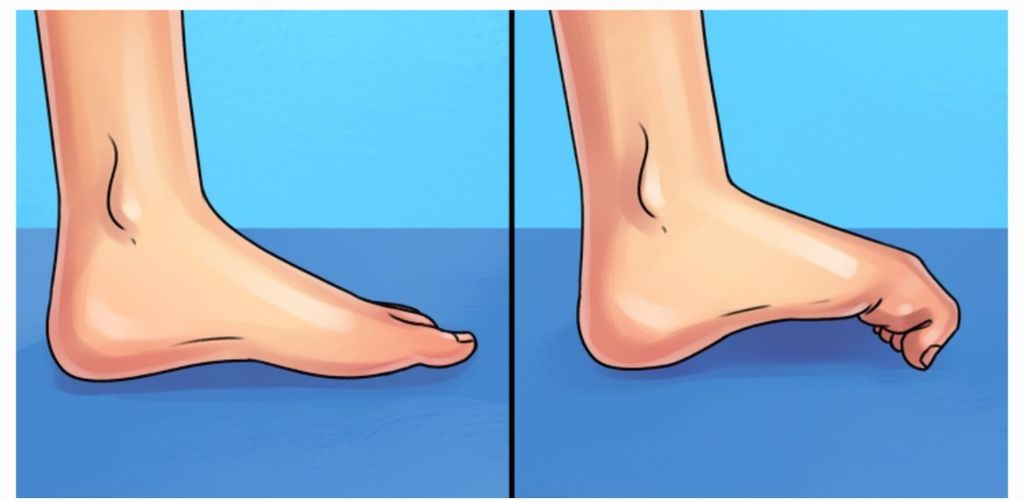
- Plantar and Toe Stretch (For Foot Pain Relief)
Benefits: Relieves tension in the plantar fascia (tissue on the bottom of the foot), helpful for heel and foot pain.
How to do it:
Sit in a chair.
Pull your toes up and back toward your shin, stretching the sole of your foot. Keep your heel on the floor.
Hold for 20-30 seconds.
You can also use a small (tennis) ball and roll it under the arch of your foot, applying gentle pressure.
Do 2-3 repetitions on each foot.
- Side-Lying Hip Opener (To Strengthen Hip Abductors)
Benefits: Strengthens the hip abductor muscles (side of the hip and thigh), which are essential for hip and knee stability.
How to do it:
Lie on your side with your legs straight and in line with your body. Support your head with your hand or one arm.
Keep your hips stable (don’t let them roll back) and slowly raise your top leg toward the ceiling, without bending it.
Hold for a second at the top and slowly lower.
Do 2-3 sets of 10-15 reps on each leg.
Important Exercise Tips:
Listen to your body: If you feel sharp pain or worsening pain, stop the exercise immediately.
Start slowly: Don’t try to do too many reps or sets at first. Gradually increase as your strength and comfort improve.
Consistency: The key to seeing results is regular practice. Try to do these exercises several times a week.
Warm-up: Do a light warm-up (like a short walk) before you begin.
Cool-down: Do gentle stretches afterward.
Remember, these exercises are a tool on the road to pain relief. Combining them with healthy habits, like maintaining a healthy weight and wearing proper footwear, is also vital.
Are there any of these exercises you’ve tried?