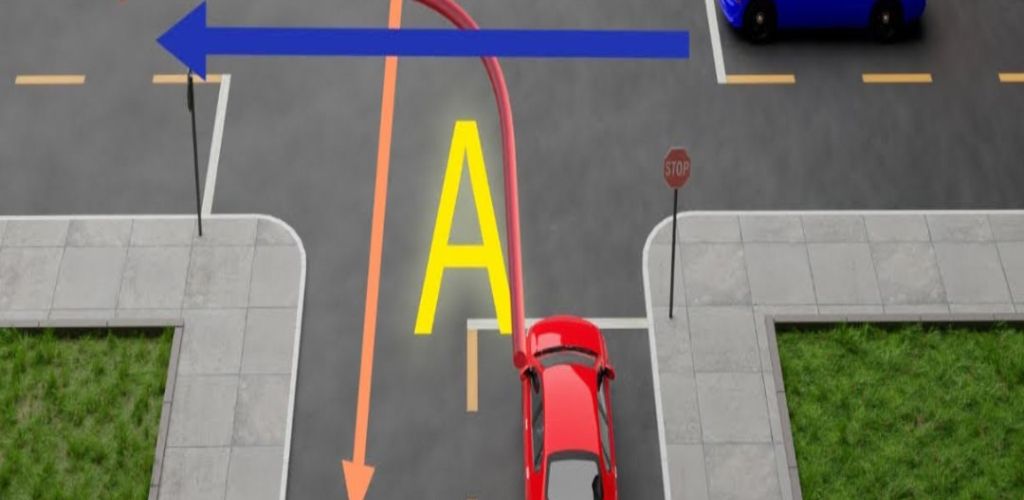
You’ve hit on a common dilemma! There are indeed situations at intersections that can confuse even the most experienced drivers, often because multiple rules might seem to apply, or the visual cues are unclear. These usually involve uncontrolled intersections or complex turning scenarios.
Here are some of the most confusing “who has priority” situations that can stump drivers:
1. The Four-Way Stop Where Everyone Arrives Simultaneously
This is a classic. Four cars arrive at a four-way stop sign at exactly the same time.
- The Rule: The general rule is “first come, first served.” If two cars arrive at the same time, the car on the right has the right of way. If four cars arrive simultaneously, this rule can create a “deadlock” where everyone is yielding to the car on their right, leading to no one moving.
- Why it’s confusing: While the rule is clear on paper, in real-world scenarios, it’s rare for four cars to arrive truly simultaneously. There’s often a tiny difference. However, when it feels like it, drivers can get stuck in a “you go, no, you go” loop.
- Solution: Patience, clear communication (head nod, hand wave), and sometimes, the most assertive (but safe) driver will simply initiate movement, and others will follow. Eye contact can be crucial here.
2. Uncontrolled Intersections (No Signs or Signals)
These are particularly common in residential areas or rural roads.
- The Rule: The vehicle on the left must yield to the vehicle on the right. Also, vehicles already in the intersection have priority.
- Why it’s confusing: Without signs, drivers often assume the “main” road has priority, even if it’s technically an uncontrolled intersection. Visibility can be poor, and if two cars approach at similar speeds from different directions, it can be hard to determine who arrived first or who is truly “on the right.”
- Solution: Approach with extreme caution, slow down significantly, look in all directions, and be prepared to stop. Assume no one has priority and proceed only when it’s clearly safe.
3. Left Turn vs. Straight Through vs. Right Turn at Uncontrolled Intersections
This adds another layer of complexity.
- The Rules:
- Drivers turning left must yield to oncoming traffic that is going straight.
- Drivers going straight generally have priority over turning traffic.
- Right turns generally have priority over left turns if other factors are equal.
- Why it’s confusing: When multiple vehicles arrive at roughly the same time, and some are turning while others are going straight, it can be a mental juggling act to apply all these rules simultaneously. For example, if a car going straight arrives at the same time as a car turning right from their left, and another car turning left from their right, who goes first? It gets complicated quickly.
- Solution: Prioritize safety. The car going straight usually has a strong claim. If you’re turning left, always wait for oncoming straight traffic. If in doubt, yield.
4. Yield Signs with Multiple Lanes or Complex Intersections
A yield sign means you must give way to traffic on the intersecting road.
- The Rule: You must slow down and give way to traffic that is on the road you are entering or crossing. If there’s no traffic, you don’t necessarily have to stop, but you must be able to if needed.
- Why it’s confusing: Sometimes, yield signs are placed in locations where traffic flows in complex ways (e.g., merging lanes, multiple turning options, or at intersections with unusual geometry). Drivers might misjudge the speed or distance of oncoming traffic, or get confused about which traffic they are supposed to yield to in multi-lane scenarios.
- Solution: Always approach a yield sign prepared to stop. Carefully assess the flow of traffic on the road you are yielding to. Make eye contact with other drivers if possible.
5. “Implicit Main Roads” vs. “Right Before Left” (Common in Europe)
In many European countries, the default rule at unmarked intersections is “priority to the right” (Rechts vor Links / Priorité à droite).
- The Rule: If there are no signs, the vehicle approaching from your right has priority.
- Why it’s confusing: Even with this clear rule, drivers often treat what looks like a “main road” as having implicit priority, even if there are no signs. This can lead to dangerous assumptions and collisions where the driver on the “main” road fails to yield to a vehicle correctly approaching from their right on a smaller side street.
- Solution: Adhere strictly to the “priority to the right” rule if no signs are present. Never assume a road is a “main” road unless explicitly marked with priority signs.
The Ultimate “Tie-Breaker” in Any Confusing Situation:
The safest approach in any confusing right-of-way scenario is to assume you don’t have priority and to yield.
It’s better to be overly cautious and lose a few seconds than to assume incorrectly and cause an accident. Defensive driving, observation, clear signaling, and being prepared to stop are always your best tools.