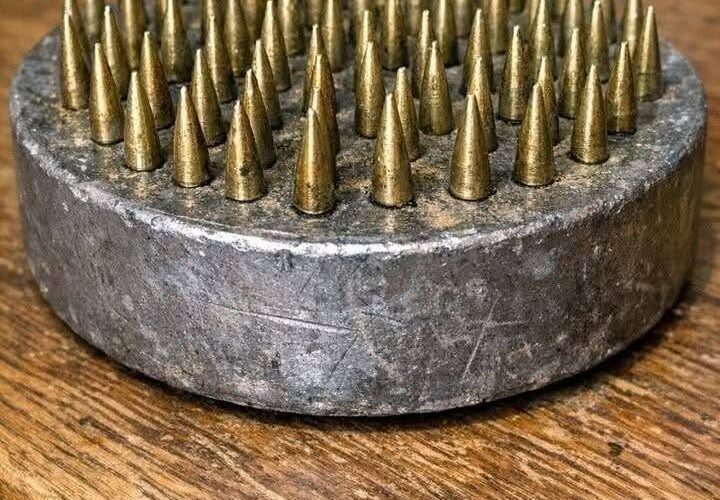
The object you found is most likely a kenzan (also known in English as a “flower frog”).
It is a traditional Japanese tool that forms the absolute foundation of the art of flower arranging—Ikebana.
What is a kenzan used for, and how does it work?
Stem stability: The heavy metal base (usually made of lead or brass) prevents heavier branches or flowers from tipping over in the vase.
Precise arranging: The stems of flowers, reeds, or branches are inserted directly onto the sharp brass or steel needles. This allows the plants to be fixed at exactly the desired angles and positions—something that would be difficult to achieve in a conventional vase.
Use in shallow bowls: The kenzan is placed at the bottom of shallow ceramic or glass bowls (vessels in the Moribana style); these are then filled with water so that the disc and its pins are completely submerged.
How do you recognize a kenzan?
Heavy weight: Even a small disc (e.g., 5–8 cm in diameter) is surprisingly heavy, as the base must support the weight of sturdy branches.
Dense arrangement of needles: The brass or stainless steel pins are spaced very closely together. Rubber ring: Many kenzans feature a removable rubber ring on the underside, which protects the bottom of delicate ceramic bowls from scratches and prevents slipping.
What can you do with it?
If you love fresh flowers, you definitely shouldn’t throw the kenzan away. Unlike green floral foam—which is discarded after use and breaks down into microplastics—the kenzan is an eco-friendly, indestructible tool designed to last a lifetime. Simply place it at the bottom of a watertight vessel, insert a few stems, and you have an elegant table arrangement.
Safety note: Since the pins are often extremely sharp and the bases of older kenzans were frequently cast from lead, handle the tool with care and wash your hands after use.