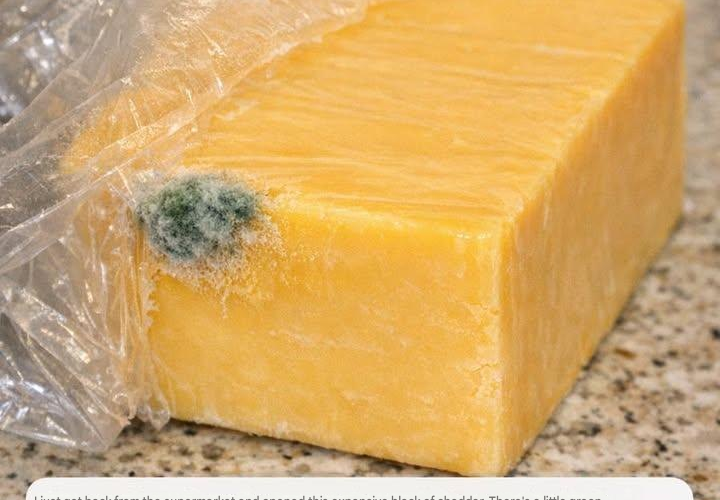
This can be really annoying—you’re looking forward to a high-quality cheese and then you find something like this. But I have good news: You probably don’t have to throw the cheese away!
Hard and semi-hard cheeses like cheddar, Gouda, or Parmesan have very different rules than soft foods (like bread, yogurt, or mozzarella).
Molds need moisture and air to grow. Because cheddar is very dense and has a low water content, molds usually can’t penetrate deep into the cheese’s structure with their “roots” (hyphae). They stay only on the surface.
Here’s how to safely save your Cheddar:
Cut off the affected area: Take a clean knife and cut away the mold, leaving a sufficient margin – ideally at least 1 to 2 centimeters around and below the green, fuzzy patch.
Avoid contaminating the rest of the cheese: When cutting, be careful not to touch the mold and place it on a clean surface. Wash the knife thoroughly after cutting.
The rest is safe: The remaining block of Cheddar that was underneath the surface is perfectly fine and can be used for dinner without worry.
⚠️ Important note: This rule applies ONLY to hard cheeses. If mold forms on soft cheeses (cottage cheese, sliced cheese) or bread, it must be discarded, as the toxins can spread unnoticed throughout the entire food.
So you can continue cooking without worry. What delicious dish are you planning to make with your Cheddar today?