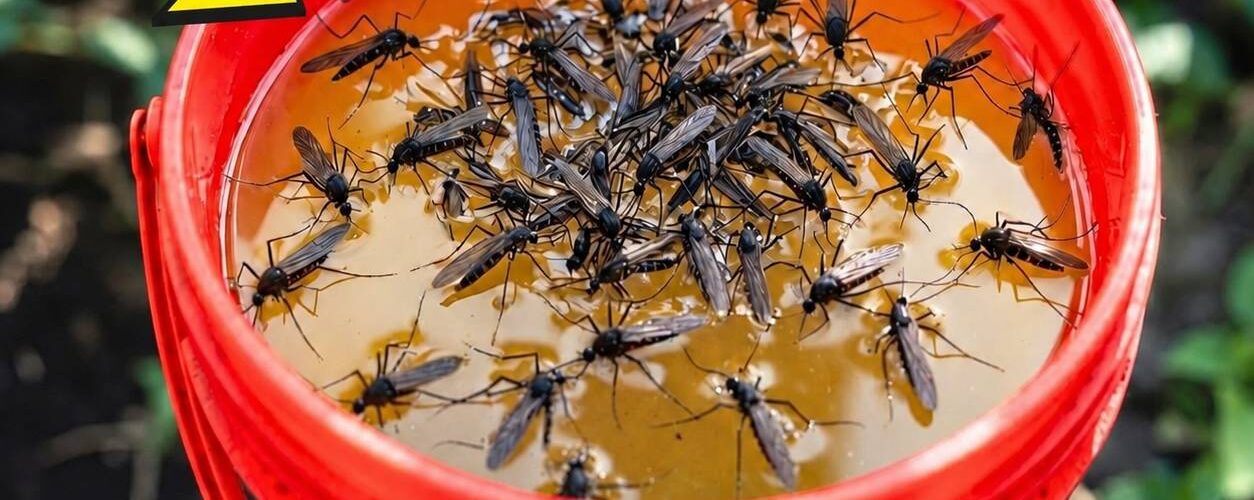
The high-sounding title brings to mind the classic “miracle remedies” found on the internet, but there’s a grain of scientific truth. If we’re talking about eliminating mosquitoes without electricity and chemical insecticides, the most effective method is not a trap for adults, but rather blocking reproduction.
The ecological method that really works is based on two pillars: lethal ovitraps (to eliminate eggs) and Bacillus thuringiensis israelensis (to eliminate larvae).
- The Ovitrap (Egg Trap)
Female mosquitoes constantly seek out stagnant water to lay their eggs. Ovitraps exploit this instinct by acting as bait.
As the diagram shows, the trap lures the pregnant mosquito inside through a special opening (entrance). The insect lays its eggs in water, but once hatched, the new mosquitoes are trapped under a metal mesh screen or a physical barrier, dying without being able to escape.
There are commercial versions (such as the Gravid Aedes Trap) or DIY variations made by cutting up a plastic bottle, painting it black (the dark color attracts mosquitoes), and placing a fine mesh just above the water level.
- Bacillus thuringiensis israelensis (BTI)
If you have drains, planters, or small pools of water that you can’t empty, the undisputed king of organic pest control is BTI.
What it is: It is a natural bacterium that can be purchased in tablets or drops at agricultural consortia or gardening stores.
How it works: It produces a toxin that destroys the digestive system of mosquito larvae only when they ingest it.
Safety: It’s completely harmless to humans, dogs, cats, birds, bees, and even fish.
The myth to dispel: The yeast and sugar trap
There’s a popular tutorial online for making a trap by cutting open a plastic bottle and placing a mixture of water, sugar, and brewer’s yeast inside to produce carbon dioxide ($CO2$), which is supposed to attract mosquitoes.
The scientific reality: This method (shown in the image above, with variations using fruit or honey) has very limited effectiveness outdoors. The amount of $CO2$ produced by the yeast is minimal compared to that emitted by a human’s breath and skin. It works well in small, enclosed spaces, but it will never solve a garden infestation.
The 3-step strategy for the garden
Survey: Empty plant pot saucers, buckets, and plastic sheeting where rainwater collects every 5 days. Without water, the tiger mosquito cannot reproduce.
BTI tablets: Place one BTI tablet every 15 days in drains and areas where water cannot be removed.
Placing ovitraps: Place ovitraps in the shade and among low vegetation, where mosquitoes like to rest and lay their eggs.