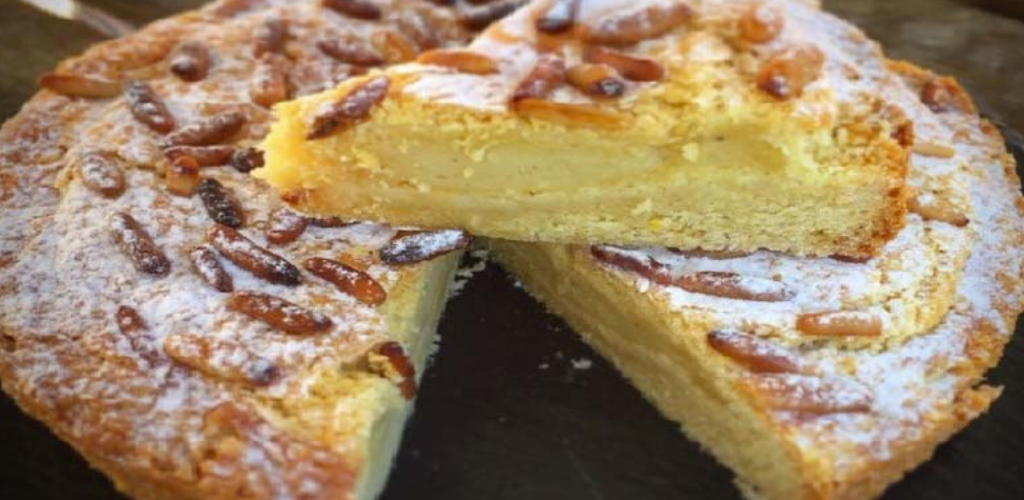
A classic of Italian gastronomy: the grandmother’s pie! A pie that smells good of the sun with lemon pastry cream and pine nuts.
The torta della nonna (grandmother’s pie in Italian) is a famous Italian pie typical of Liguria and Tuscany, which is often found on the dessert menu of restaurants.ANNOUNCEMENT
This is a fairly simple dessert to make, consisting of two discs of shortcrust pastry filled with pastry cream, which are covered with pine nuts.
It is a pie – a pie, to tell the truth – pleasantly flavored with lemon zest, where in a thin shell of sweet shortcrust pastry and covered with pine nuts hides pastry cream. I suggest you make the “torta della nonna” yourself: here is the recipe!
Ingredients / For 8 people:
For the sweet shortcrust pastry:
– 1 organic lemon (to use the zest)
– 1 tbsp. coffee vanilla extract
– 1 sachet of baking powder (7 g)
– 4 egg yolks
– 200 g caster sugar
– 200 g semi-salted butter
– 400 g T45 flour
For the pastry cream:
– ½ organic lemon (to use the zest)
– 500 ml milk
– 40 g cornstarch (if not available, use potato starch or T45 flour)
– 100 g caster sugar
– 4 egg yolks eggs
For the finish:
– icing sugar
– around 70 g of pine nuts
Preparation :
The shortcrust pastry: in a large bowl, mix together the flour, sugar, baking powder, grated lemon zest and vanilla extract. Dig in wells, add the egg yolks in the middle and the butter cut into small pieces.
Knead everything quickly with your hands (or in a food processor) until you get a dough. Shape it into a ball, wrap it in cling film and let it rest for at least 30 minutes (1 hour if it’s hot) in the refrigerator.
Pastry cream: pour the milk into a small saucepan, add the zest (whole, not grated) of half an organic lemon, bring to the boil, then strain the milk into a container to get rid of the lemon zest. Keep warm.
Off the heat, pour the egg yolks into another saucepan, add the sugar, mix with a whisk or an electric mixer until the mixture whitens. Pour in the cornstarch, stir with the whisk, then gradually pour the milk over the mixture, still stirring with the whisk.
Put the saucepan back on the heat, stir with the whisk until the cream thickens. Then remove it to a large container (this makes it easier to cool the cream) such as a glass gratin dish, cover with cling film and let the cream cool completely.
The pie: preheat the oven to 160° (ventilated oven) butter a 26 cm diameter pie tin. If you don’t have a springform pan, line your pan with parchment paper so you can easily unmold the pie once baked.
Put the plastic film on the dough, cut it into two pieces of 2/3 and 1/3. Using a rolling pin, flatten the largest pieces of dough (the 2/3 one) between two sheets of parchment paper to obtain a rather thin thickness, around 0.5 cm. Place the disc of dough thus obtained in the mold, in order to have the bottom and the edge of your pie.
Pour the pastry cream into the bottom of the pie, spread it well.
Then, have the roller flatten the remaining 1/3 of the dough in the same way, in order to obtain the cover of your pie. Cover the pie with this disc of dough, gently placing it on the cream. With your fingers, press all around the edge of the pie to seal the two disks of dough and prevent the cream from coming out during cooking. With a knife, trim away the excess dough all around to get an even edge for your pie.
Brush the surface of the pie with egg white, then sprinkle with the pine nuts.
Put the pie in the oven and let it cook for 30 to 35 minutes.
Once cooked, remove the pie from the oven and let it cool before gently unmolding it onto a large plate.
Sprinkle with icing sugar before serving.
TIPS:
Be careful when cooking: with a ventilated oven, it must be cooked at 160° for 30 minutes, which gives a better result. If you only have a static oven, you will have to cook it at 180° but you will have to watch that the pie does not become too dark.